Center for Culture of the Region of Central Macedonia
the challenge
Institutional Guidelines
Operating within a public cultural institution meant navigating strict communication guidelines, formal approval processes, and a responsibility to represent regional identity with accuracy and respect. Every message, visual, and campaign needed to align with institutional standards while remaining engaging to a broad and diverse audience. Balancing creativity with public-sector accountability was critical, as content needed to be informative, inclusive, and culturally sensitive without feeling static or disconnected from modern audience behavior.
Additionally, events varied significantly in scope, theme, and audience profile, requiring a flexible yet structured marketing approach. Each initiative needed its own identity while remaining clearly connected to the overarching mission of the Center for Culture and the Region of Central Macedonia.
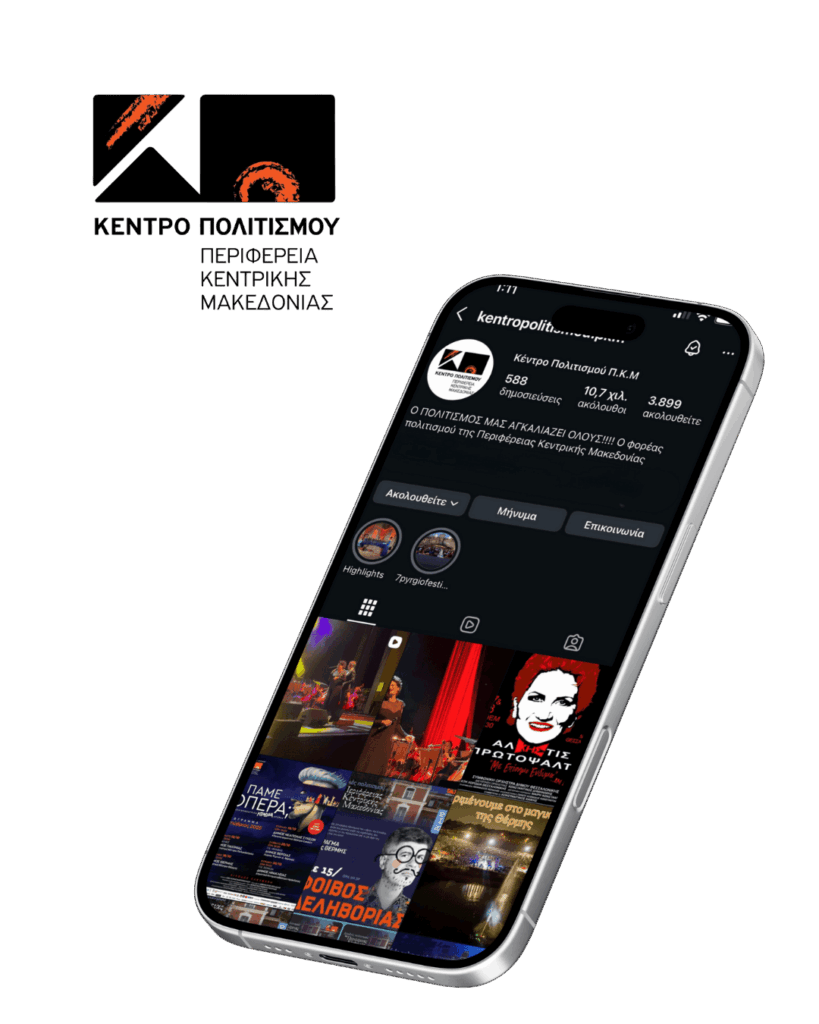
Engagement & Audience Activation
Beyond institutional constraints, the primary challenge was engagement. Cultural events compete for attention in a fast-moving digital environment, where audiences are selective and expectations are high. The Center needed to increase visibility, communicate value quickly, and encourage real-world participation through digital channels.
This required translating cultural programming into compelling narratives that resonated online, without oversimplifying or diminishing their significance. The challenge was not just promotion, but creating sustained interest, anticipation, and continuity across events, platforms, and audiences.
the strategy
Turning Cultural Vision, Public Identity, and Regional Values Into Event Strategies That Engage, Inform, and Mobilize Audiences
We transformed the Center’s cultural mission, regional role, and event programming into a structured communication strategy designed to activate public engagement. The strategy focused on positioning each event as both a cultural experience and a shared public moment, ensuring clarity, accessibility, and relevance across digital platforms. By aligning event marketing and social media execution with institutional values, we preserved credibility while adapting tone, formats, and timing to contemporary audience behavior. Through audience analysis, content planning, and performance-driven decision-making, we created a framework that amplified visibility, strengthened participation, and supported consistent engagement without compromising the identity or purpose of the institution.
The Execution
Event Marketing Framework
We developed a structured event marketing system that ensured each initiative was clearly communicated, properly positioned, and easy to engage with. Event information was organized to guide audiences from awareness to attendance, covering key details, timelines, and value propositions with clarity. This approach ensured consistency across campaigns while allowing flexibility for different event formats and themes.
Social Media Strategy & Content Planning
Social media was used as a primary channel for audience engagement, awareness, and momentum building. We designed platform-specific content strategies that balanced informational posts with engaging visuals and timely reminders. Each event followed a content lifecycle that supported pre-event anticipation, live engagement, and post-event visibility, reinforcing continuity and audience connection.
Tone, Messaging & Visual Consistency
All content adhered to institutional tone guidelines while remaining approachable and engaging. Messaging was carefully crafted to reflect cultural significance, inclusivity, and public value. Visual elements followed a consistent system that aligned with regional identity while allowing each event to maintain its own character.
Scheduling, Coordination & Delivery
Campaigns were executed with precise timing to maximize visibility and attendance. Content calendars, posting schedules, and coordination workflows ensured smooth execution across platforms and stakeholders. This structured approach reduced friction, improved responsiveness, and maintained quality control throughout the campaign lifecycle.
The Results
01
The Center for Culture achieved stronger visibility and clearer communication across its event programming. Digital campaigns increased awareness and provided audiences with a reliable source of information, reinforcing the Center’s role as a cultural reference point within the region. Events were presented with consistency, professionalism, and clarity, strengthening public trust and recognition.
02
Social media engagement improved through structured storytelling, timely communication, and audience-focused content. The approach supported higher interaction, improved reach, and sustained interest across multiple initiatives. Rather than isolated promotions, events became part of an ongoing cultural conversation, helping the Center build momentum and long-term audience connection.
Conclusion
KARISMA’s partnership with the Center for Culture of the Region of Central Macedonia demonstrates that thoughtful, structured marketing can both honor institutional values and energize audiences. By combining strategic insight, disciplined execution, and audience-focused storytelling, we transformed the Center’s digital presence into a platform that educates, engages, and inspires.
The result is a scalable framework for all future initiatives, one that balances creativity with accountability, amplifies public participation, and ensures every cultural event resonates long after it ends. Our work shows that digital marketing is not just promotion, it is a tool for cultural connection and civic engagement.