University of Piraeus
the challenge
Institutional Precision & Strict Guidelines
The University of Piraeus operates within a highly regulated academic and institutional framework. Every digital touchpoint needed to respect strict brand guidelines, formal tone requirements, accessibility standards, and internal approval processes. Unlike commercial projects, there was zero margin for ambiguity, inconsistency, or visual excess. Language, structure, hierarchy, and design choices had to be academically credible, institutionally aligned, and legally compliant at every level.
Beyond visual identity, the challenge extended to content accuracy and clarity. Information had to be presented in a way that was authoritative yet accessible, ensuring that academic terminology, program structures, and administrative details were communicated without confusion or misinterpretation.
Multi-Audience Complexity Under Time Pressure
The websites needed to serve multiple audiences simultaneously: prospective students researching programs, enrolled students seeking academic and administrative information, faculty members, and external stakeholders. Each audience had different needs, expectations, and levels of familiarity with the programs.
At the same time, timelines were tight. Program launches, application cycles, and academic schedules created significant time pressure. Every deliverable had to be completed, reviewed, and launched on schedule, without compromising quality, accuracy, or compliance.
the strategy
Turning Academic Excellence, Institutional Identity, and Program Value Into a Digital Experience That Informs, Guides, and Converts
We translated the University of Piraeus’ academic strengths, institutional credibility, and program-specific value into a structured digital strategy designed to serve multiple audiences with precision. The platform was developed to function both as an informational hub for enrolled students and as a clear, accessible gateway for prospective applicants exploring their academic options. Every structural and content decision respected strict institutional guidelines, tone requirements, and branding standards while ensuring clarity, usability, and trust. By combining strategic information architecture, disciplined design execution, and deadline-driven delivery, we created a digital environment that supports applications, communicates academic value, and reinforces the department’s authority without compromising consistency, accuracy, or institutional integrity.
The Execution
Custom Academic Website Architecture
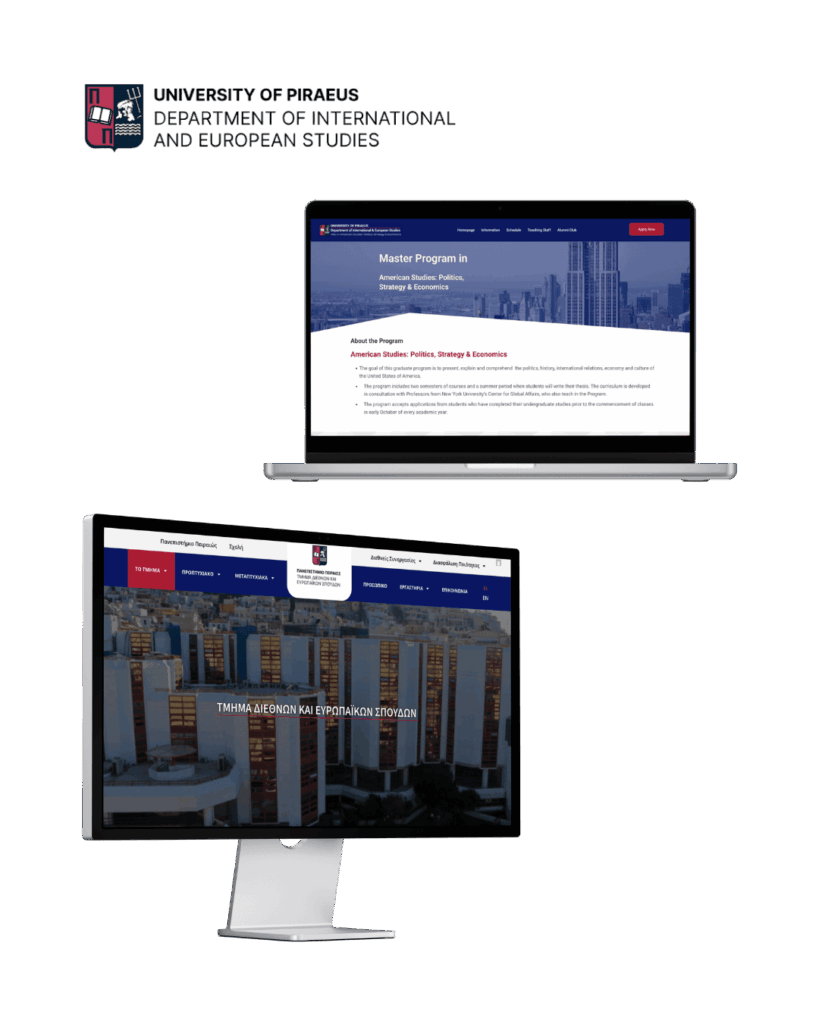
We designed and developed a fully custom website solution for the Department of International & European Studies and its three programs:
Master in International & European Studies
MSc in Energy: Strategy, Law & Economics
Master in American Studies: Politics, Strategy & Economics
Each program was given its own clearly defined structure while maintaining visual and functional consistency across the department. This ensured clarity without fragmentation and individuality without deviation from institutional standards.
Information-First UX & Navigation Design
Navigation was engineered around real user behavior. Program details, course structures, faculty information, admissions requirements, and academic resources were logically grouped and easy to locate. The result was a user experience that supports fast access to information without sacrificing depth or academic integrity.
Mobile-First & Accessibility-Oriented Design
The platform was built with a mobile-first approach, ensuring accessibility across devices for students, faculty, and international audiences. Layouts, typography, and interaction patterns were optimized for clarity, readability, and compliance with accessibility best practices.
SEO & Performance
Despite the institutional nature of the project, long-term discoverability remained critical. The websites were built on clean, SEO-ready foundations that support structured content, search visibility, and future expansion. Performance optimizations ensured fast load times and stable operation, even under high traffic periods such as application deadlines.
Social Media Alignment & Digital Consistency
Alongside the website, we supported social media presence to ensure consistent messaging and visual alignment across channels. This helped reinforce program credibility, increase visibility, and direct traffic toward the newly built digital platforms.
The Results
01
A Unified Academic Digital Hub
The final result was a structured, authoritative digital environment that successfully serves both prospective students and current academic communities. The websites now function as a reliable point of reference for information, applications, and academic resources, reducing confusion and improving overall user experience.
02
Credibility & Long-Term Scalability
By respecting strict guidelines while introducing clarity and modern usability, the project strengthened the department’s digital credibility. The infrastructure supports long-term updates, program evolution, and content expansion without requiring structural redesigns, ensuring sustainability beyond the initial launch.
Conclusion
This project demonstrates how strategic digital execution can elevate institutional communication without compromising academic integrity. By combining structure, clarity, and precision with modern design and technical reliability, the University of Piraeus now benefits from a digital presence that reflects the quality, seriousness, and ambition of its academic programs.
At KARISMA, we don’t simplify complexity, we organize it. And when precision matters, strategy becomes the foundation for trust.